Showing posts with label evolutionary psychology. Show all posts

Friday, January 16, 2009

The Monogamy Puzzle


The Monogamy Puzzle


There are a lot of opinions roaming about the blogosphere regarding whether or not people are "supposed to be" monogamous.  I'm going to try to take an in depth look at this topic from several points of view.  Hopefully, by the time you're done with this article, you'll have some idea about what science says, and that will allow you to evaluate your own moral feelings and emotions against something a little more concrete.  Before reading on, I do feel like I need to emphasize that descriptions are not instructions.  I'm not in any way trying to tell you what you as an individual should do.  Instead, I'm trying to give you something scientific on which to base your own decisions -- something more than gut feelings.  Humans are widely varied in their desires, so I certainly do not presume to tell you what yours ought to be.


To begin, I'm going to tackle human sexuality from both sides, male and female. This may seem the obvious choice, but just to be sure, let's remember that sex is competition. Males and females have their own interests, evolutionarily speaking, and we have hopefully dispelled the myth that human intelligence puts us above other animals. Like chimps and dolphins and killer whales, we are very intelligent social animals, and examining our behavior is the same as examining that of any other creature. If we see a pattern of behavior, there is a reason for it. Anything that exists is a product of evolution, including our intelligence and our incredibly complex society. If we look well into our past, we will understand the mechanisms behind our behaviors. If we are lucky, we will be able to take the lesson of sugar consumption to heart, and we will be able to make some educated statements about what we should do if we want to achieve a particular result. 

So, on to the question of monogamy. Before answering decisively, I must make a distinction about the word itself. There are two very different ways of asking the question – that of a social scientist and that of a sociobiologist. An anthropologist who speaks of monogamy is talking about marriage, or whatever cultural equivalent there might be. A species is monogamous if males and females have one official partner. This does not take adultery into account, nor does it account for serial monogamy, which is the practice of having one partner for a relatively short period, and then moving on to another partner. On the other hand, a sociobiologist who speaks of monogamy is speaking of the actual practice of mating. A species is only monogamous if it really has only one sexual partner. Any mating is considered part of the equation, and social institutions are not considered.

For the time being, I will be using the sociobiological application of the word. When I speak of polygamy, I am speaking of the practice of having multiple sexual partners, regardless of institutionalized or cultural norms. Similarly, monogamy will only apply when a species really does mate with only one partner. Just as in our mental exercise with sugar cravings, we must first understand how we behave, and then we must understand why. Only then can we begin to look at ourselves as individuals and begin to think about goals and how we should act if we wish to achieve them.

Finally, then, the answer to the question. Are humans monogamous? The short answer is no. We are mildly polygamous. The long answer requires addressing the question from various points of view. Culturally, we have always focused on a single marriage between a man and a woman, but there are two unavoidable facts that we must not overlook, even if they are incriminating or cause us personal discomfort. First, though marriage has virtually always been between one man and one woman, mating has not. Since the agricultural revolution, powerful men have virtually always kept harems. In fact, this practice has only fallen out of favor since industrialization. Contrary to the notion of the faithful middle class man, polygamy was not restricted to the very powerful. It was only institutionalized for them. Men have been cheating as long as they have been marrying, and not just a little bit. Cheating is almost as common as marriage, historically.

If we compare anatomy and biology, we find this conclusion to be valid. There is a clear and virtually indisputable link between the size of the testicles and the fidelity of the species. Ours are not large enough for a thoroughly promiscuous lifestyle, like the chimpanzee's, nor are they as small as the most monogamous apes. Human males are not large enough, compared to females, to command harems in the same way as a gorilla. We are not antisocial enough to be as monogamous as gibbons. In all biological areas, we fall above the threshold of monogamy, and below that of outright polygamy.

If this conclusion leaves you feeling uncomfortable, try to keep that feeling at bay for a while. I promise this will make a lot more sense once we've examined the evolutionary developments that led us to this perilous double standard of demanding monogamy and practicing polygamy. If it helps you to understand the point, think about yourself for a minute, and your partner, if you are attached. If you are over the age of thirty, you've probably had between three and ten sexual partners, and most of them have been monogamous partners, though there's somewhere around a thirty or forty percent chance that you've cheated at least once in your life. Now, your partner has probably had around the same experience, and if you think about it, most of your friends have, too. Humans do not have sex monogamously today, and as we will see, they never have.

Game Theory and Mating Standards


Why would a species evolve into a particular mating pattern? Why aren't all species either polygamous or monogamous? In order to understand the answer to this question, we can think of evolution as a game of strategy, with each side using whatever advantage it has, and trying to minimize its weaknesses. This is where game theory comes in.

Imagine a species that is polygamous. This means that the most powerful males have many females in a harem. If you are a male, you have two choices. You can either be one of the most powerful males in the group, or risk celibacy. No matter how dominance is chosen, the losing males find themselves without mates. This is not just conjecture. It has been thoroughly documented in nature. The more polygamous a species, the more the average male suffers. Only the most powerful get to pass on their genes. The rest literally die for eternity.

While this brutal male selection is going on, the females pretty much have everything they could ask, right? All of them get to mate, and they all get one of the crème de la crème as a husband. Well, in a sense, this is true, but there are disadvantages. For one thing, as the degree of polygamy increases, the amount of attention the male can devote to each female decreases. Though the offspring will be the children of royalty, they will have been raised essentially by a single parent. Furthermore, as the old adage goes, if everyone is special, nobody is. In other words, being the child of the king isn't particularly advantageous if everybody is a child of the king! In the next generation, each male will be on equal footing when competing for females. Since all the genetic material comes from the king, it's basically a matter of luck and the female's genes.

Eventually, this kind of system will reach a point of diminishing returns, where the females do not receive a significant benefit from mating with the most desirable male. When this happens, the most clever of the celibate males might figure out that he has an advantage. (Again, I am speaking very liberally about conscious decisions. This is for ease of understanding, and does not imply that evolution is intentionally doing anything.) If he devotes himself entirely to one female, and dotes constantly over the children, the female is actually gaining something by marrying down on the social ladder. As more and more females realize this advantage, monogamy creeps up on polygamy. It may eventually surpass it as the primary mating arrangement.

This works in reverse, of course. In a completely monogamous population, females are stuck with who they get. If only twenty out of one hundred males are attractive and strong, that means that eighty females are forced to mate with a dud. If strength correlates to resources, as it often does, clever females will eventually figure out that a half of a rich male is better than all of a poor male. Even with half of the parental attention, the benefit in resources is more than enough to make up the difference. If there is a mechanism by which males can accumulate vast resources, such as a large territory, or a particularly rich food source, polygamy will overtake monogamy.

As we might expect, complete monogamy is pretty rare in nature. Most animals fall somewhere in between strict monogamy and rampant polygamy, which is consistent with the theory that ecology and internal competition create a fluid and self-correcting system. Either system creates an inherent advantage for one gender or another, based on resources, population density, and many other factors.


So What About Humans?
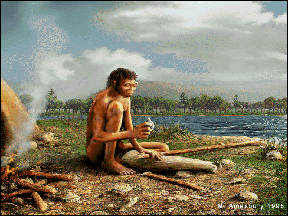

Homo erectus was the most carnivorous monkey or ape ever. He represented a sharp divergence from the now extinct Australopithecus robustus, who lived almost exclusively on leaves, seeds, and fruits. Though it may pain some vegans to hear this, our entire society is very likely the result of our ancestors' love of raw meat. You see, in order to hunt meat, humans had to roam far from home. Unlike plants, prey animals do their best to get away – and stay away – from their predators. Not only that, but our pre-human ancestors were not nearly as fast as most of their prey. We gained much by standing on two legs, but we also lost much. For Homo erectus, the hunt required allies. Groups of men had to form social bonds, and then set out on the hunt, perhaps for days or even weeks at a time, until they were able to secure a large enough prize to bring home. Not only did man need social bonds, but he needed spears, for he lacked the claws and teeth of the other top predators. Both of these things require a big brain. As it turns out, this is the major difference between our extinct ancestors and ourselves. We were the only ones who figured out how to make tools, form groups, and kill big animals.

For over a million years, humans didn't evolve much. Our environment was stable, and we had achieved a stalemate with natural selection. We lived in small groups, formed pair bonds, experienced jealousy, lust, and emotional hurt. We were busy just trying to stay alive, and we hadn't discovered how to farm, so there was no way to build up enough resources to become highly polygamous. By all estimates, only the most elite males could be openly polygamous, and then, only with a small number of females. As for cheating, the jury is still out to some degree, but there is very strong circumstantial evidence suggesting that it was at least relatively common for all of our history.

Within the animal kingdom, there is a remarkably consistent tendency. The smarter the animal, the more flexible are its mating habits. We can see this very clearly in chimps and coyotes, two species that are very similar to humans in many societal ways. The degree of polygamy in both of these species changes slightly based on the availability of resources. With humans, we would expect that this tendency would apply, and as we progress in history, we will see that not only is this true, it is spectacularly true.

In a hunter-gatherer society, there is very little skill involved in staying alive. Either the food is there to pick, or it isn't. Either the herd is nearby, or it isn't. For this reason, there was no way for males to build up reserves, or to guarantee food in the future. The conclusion is clear. With no particularly powerful males, polygamy would never become the dominant mating model. However, things changed with the agricultural revolution. Once we figured out how to grow our own crops, our big brains kicked in at an astonishing rate.

As soon as one male accumulated more food than he and his mate and children could eat, he discovered the power of money. Obviously, he had no concept of the abstract currency we use today, but it was clear that he could use his excess food to buy the loyalty of his fellows. As labor goes, farming two fields is not significantly more difficult than farming one, especially with a little help. Soon, what was a slight excess of food became a large excess, which allowed the purchase of more loyalty. Man had discovered how to become rich. With this discovery, he changed the dynamic of mating by allowing females the option of choosing a portion of a very rich man over all of a very poor man. Polygamy was here, and it was not going anywhere for a long time.

In all of human history, pastoral societies have been polygamous, almost without exception. At the dawn of human 'civilization,' when we learned to build cities, kings and emperors and local rulers generally had thousands of women in harems. Kings had ultimate authority, and ultimate access to mates. In some South American nations, it was rare to find a child who was not royalty. Until as late as the 20th century, many parts of the world were still operating within this model. Though it's not always pleasant for us to think about, the reality is that for virtually all of our history as agriculturalists, women have been monopolized by powerful men, leaving large swaths of the male population celibate.

Perhaps now is a good time to take a step back and try to look objectively at what we've learned. Please bear in mind that I am not suggesting how people ought to act, or how many wives a man should have. Also, please remember that, just like our taste for sugar, our drive to compete and our tendency to stratify our society is completely natural. Men are evolutionarily programmed to behave the way they do. It is incorrect to say that man became polygamous because of deficiency of morality, or because of a fault in his character. Simply put, the strategy that man discovered has been extraordinarily efficient. A population of a few million has become a population of six billion. This is no small feat, and as far as evolution is concerned, for a species as big as humans, it's nothing short of a roaring success. We're going to leave this topic for a while, but I promise you that later on, we will return to polygamy and discuss exactly what's wrong with it. In the meantime, we need to look at males and females separately.


Why Men are Lying Cheaters


In any species, sex is a competition. The females, with so much at stake, must choose their mates with great care, selecting the best male for genes, post-natal protection and childrearing duties. The males, on the other hand, have very little at stake genetically, and virtually nothing in time expended. (Women, feel free to make your 'minute-man' jokes at this point.) They literally have no compelling reason, in and of themselves, not to try to impregnate as many females as possible. With this notion as a starting point, let's examine human males, and see if we can discover just what it means to be a man.

The first thing we must know about males is that they tend to produce more children than females. This seems counterintuitive at first, but it's true. Men who marry twice are more likely to have children by both wives, and women are less likely to have children with their second husband. Add to this the fact that one particularly promiscuous male could have perhaps four or five wives in the course of a lifetime, all the while availing himself of the services of prostitutes and mistresses, and you will see the truth in it. Men produce more children than women.

If there's something twitching the back of your head about this, it's probably the question of how to work out the math if men produce more children than women. Obviously, there's a real number of children in the world, and it takes one man and one woman to make a child, so that can't be the way it is, can it? Yet, the numbers are astonishingly clear. Across all cultures, men who are fathers have more children than women who are mothers. It is undeniable. The only question is how we can interpret this information. What is the answer to this apparent paradox?

The answer is obvious, if painful. The only way for this to be possible is if virtually all females produce children, and many men do not. This is, as it turns out, completely true historically. There has always been a significant number of celibate men, usually the least powerful, or the poorest, or the ugliest. Furthermore, the ratio of men to women has always been essentially one to one. If for no other reason than this, we can say with certainty that humans are polygamous. (As we will see later, cuckoldry also plays a part in this odd equation, but not enough to explain the discrepancy completely.)

The next thing to know about men is that they must seduce women. Despite libraries full of feminist literature extolling the virtues of confident women asking men out, it remains the very rare exception to the rule. For all of human history, men have seduced women. This, too, lines up very neatly with other creatures who share similar mating patterns. In nature, the gender which spends the least amount of time in reproduction does the seducing. In the few species where males tend the young, or even more rare, carry them in their bodies, females do the courting, and males do the selecting.

Men are not entirely ignorant in their pursuit of sex. Overwhelmingly, we see a historical trend that is at least somewhat promising. Most men, having achieved a monogamous marriage, try very hard not to lose it. This doesn't mean that they don't cheat. It does mean that they usually go to great lengths to hide their indiscretions if they don't have the power to enforce polygamy. Most men, it seems, have a vested interest in maintaining something close to a monogamous relationship.

One of the most obvious traits males exhibit is their tendency to compete. Sport is ubiquitous, and until quite recently in our history, was virtually monopolized by men. Testosterone is clearly linked to aggression. Men compete for jobs, for money, for land, for possessions, for women, and pretty much anything else of value. This drive to compete is a direct result of female selection. That is to say, because females choose the best males (whatever the criteria might be), the males must compete so that the female can choose properly. It's a cruel twist of fate that the 'right to choose' inherent in females is what led to the complete domination of females by men after the agricultural revolution. Once men learned how to become rich, they learned how to become kings. It was only a short jump in logic to realize that kings (the winners) could have as many mates as they wanted. In all six of the early civilizations – Babylon, Egypt, India, China, Aztec, and Inca, one man ruled with complete authority, and had rights to virtually any females he wanted. There are records of some rulers complaining of their regimens, as many kings were literally obliged to perform sexually at least two times a day every day with different concubines. In all of these civilizations, there were elaborate records noting exactly when each concubine would be the most fertile. Clearly, to males, sex is something to be fought for and won.

What is more notable than the behavior of kings is the observation that kings were not special in kind – only degree. Across all of these cultures, men with power had harems of proportionate size. As wealth diminished, so too did the quality and exclusivity of the harem, but the desires and goals of men are clear. Even among the lowest level of landowners, there was rampant polygamy. The Roman Empire is a perfect example of this. Though marriage was between one man and one woman, we can learn a lot from the slave trade. Most of the actual labor was done by male slaves, for obvious reasons, yet young female slaves brought the highest price on the open market. Not only that, relatively small houses were often filled with an inordinately high number of female domestic servants, who were, by and large, all young. More convincingly, Roman nobles freed many of their slaves at remarkably young ages, leaving them large inheritances. The common thread? All of them appear to have been children of slaves. Why else would they be freed, except that they were illegitimate offspring?

Though we think of Christian Europe as a monogamous place, it's just not true. Polygamous mating was kept more secret, but it was no less prevalent. The countryside was male dominated, leaving many men celibate, primarily because castles and monasteries employed huge numbers of serving maids. In some cases, contemporary historians explicitly mention “gynoeciums,” where the secret harems of castle owners lived. Add to this the fact that among men with one wife and no servants, there is no indication whatsoever that cheating was any less common when there was an opportunity for it.

The last thing that we must realize about men is that they are violent, and that their violence has a lot to do with sex. It has been convincingly demonstrated that war among humans did not originate over resources, but mates. All studies of preliterate societies reveal very high levels of violence between men, with the inevitable result being the capture and sexual conquest of the females. In earlier historical periods, rape was one of the most attractive incentives used to recruit soldiers. Even today, rape is not uncommon in war, and shore leave is at best a thinly veiled excuse for soldiers to buy the services of prostitutes.

To quote Matt Ridley, to whom this essay is unquestionably indebted, “The nature of the human male, then, is to take opportunities, if they are granted him, for polygamous mating and to use wealth, power, and violence as means to sexual ends in the competition with other men – though usually not at the expense of sacrificing a secure monogamous relationship.” (The Red Queen, 206) As we will see in a moment, human sexual competition is not one sided. Females have their own games to play, and their own motivations. Clearly, the domination of rampant polygamy is at an end, for when we look around the world today, we see that even the most powerful men must now at least make a good show of discretion with their mistresses. Although cheating is still very common, and multiple marriages are the norm, there has obviously been some dynamic that has caused a shift in the balance of power. Men don't get everything they want, no matter how powerful. We must explore the nature of females to discover what has caused this.

Why Don't Women Bear Their Husband's Children?


We've pretty firmly established that men are scum, right? All they want to do is have sex with as many women as they can, and the only thing stopping them is their own level of power, right? Well, not exactly. This picture is entirely one-sided, and doesn't account for the fact that through most of human history, women have been able to enforce near-monogamy on men. How did they do that, exactly? Moreover, is it fair to say that women have been nothing but the pawns of men for all of history? Are they little more than incubators for male genes to be passed through?

It's easy to understand why women often describe history as an entirely male dominated story. It's also easy to understand that women are often frustrated by the apparent paradox. If women have so much power as the selectors, why do they always end up on the short end of the bargain? When the men leave, women are the ones left holding the baby and all the responsibility, and the men get to go out and make more babies, with little or no consequence to themselves. For all the power women are supposed to have, they still can't seem to get paid as much as men, and they've had to fight tooth and nail for everything they've ever gotten. You never hear about men being left at the altar, do you? Women just want a man who will be faithful, and then they'll be happy, right? If only men would be faithful, everything would be perfect.

As it turns out, there really is a paradox that explains how women impose monogamy on men, and it fits perfectly with the ever-growing body of evidence that suggests that nearly everything we think of as being “above nature” about humans is actually evidence that we are unavoidably tied to our animal roots. Here, then, is the answer to why men marry, and why they prefer long term relationships with one woman. Women cheat. Often.

One of the most dramatic advantages, genetically, of being female is that there is never any doubt of parentage. In other words, a mother knows with 100% certainty that her child is her own. (This, of course, doesn't take into account modern medical procedures, but you get the point.) Since evolution is not concerned with ethics, only successful reproduction, it stands to reason that females would have learned to take advantage of this fact. They clearly have. Though the numbers vary slightly depending on the particular culture, one thing has been proven rather conclusively. In cultures that are primarily or strictly monogamous, cuckoldry is common. In the landmark study, conducted in Liverpool in the 1980s, it was discovered that less than 80% of children were actually related to the man who believed himself to be the father.

If it is true that human nature is the cause of this phenomenon, we ought to see biological evidence. It so happens that the evidence is striking. Recent investigations of the female orgasm have given us a rather shocking dose of reality. It has long been known that there are some female orgasms that cause more sperm to be retained after sex. These are called high-retention orgasms. Obviously, high retention orgasms have a higher probability of inducing pregnancy. What was shocking to researchers was when they examined orgasms alongside fidelity. In faithful wives, approximately 55 percent of their orgasms were high-retention. However, among unfaithful wives, only 40 percent of their orgasms with their husbands were. Even more shocking, though, was the fact that over 70 percent of the orgasms with their adulterous lovers were high-retention. There is more. Without consciously being aware of their most fertile period, women tend to have sex with their lovers on their most fertile days.

The combination of these numbers is shocking. Though women tended to have sex with their husbands twice as much as their lovers, they were slightly more likely to conceive with their lover than with their husband. It appears that women have a biological drive to keep their husband while bearing the child of another man. Again, if this is true, we should be able to make predictions based on other animals who behave similarly. Again, we can.

In a previous essay, I noted that human females are rare in comparison to the rest of the animal kingdom. Rather than having a small window of sexual availability and interest, they are sexually active essentially all the time, but only fertile a small percentage of that time. Another aspect of this system is that fertility is concealed. Except in very recent years, there has never been an accurate measure of peak fertility. One immediately apparent advantage to the female is that this system allows her to choose her mates much more selectively. If, like other animals, human females displayed fertility with a clear physical sign, and were only receptive to sex during this period, men would only be interested during these few days, and culture would be much, much different. As it is, women have as many days as they want to choose between as many potential suitors as they desire.

There is an odd side effect of concealed ovulation. Since ovulation is concealed, adultery becomes easier, for on any given day, the woman can leave in secret to have sex with her lover, and her husband, ignorant of her fertility, is none the wiser. As we have seen, whether they know it or not, women are instinctively aware of this fact, and use it to their advantage when they do have affairs.

Why would female cheating have such a profound effect on men? After all, men are supposed to be interested in having sex with as many women as possible. Why would female cheating be such a threat? Like other polygamous animals, humans produce 'smart sperm.' Some sperm avoids trying to get to the egg, instead forming a kind of blockage that prevents other sperm from getting in. Other sperm are literally attack sperm, actively trying to destroy sperm from competing males. All of this is a testament to the fact that even on a cellular level, men really don't want other men having sex with their women. The math is clear. If many men have sex with a woman, the chance of any one man being the father is dependent on how many men there were. On the other hand, if a man can keep his woman faithful only to him, there is a 100 percent chance that he is the father. It almost goes without saying that virtually all the laws in history regarding adultery have been geared towards punishing women for having more than one man. Our biology predicts this.

There is a clear pattern in nature. In species that have rampant adultery, particularly birds, interest in frequent sex is almost always observed. Birds turn out to be the closest analog to humans, sexually. Like many species of birds, humans live in colonies. Swallows, in fact, are very close to humans in their sexual practice. Consider this. In swallows, 'married' females often have affairs with dominant older males, but they do it in secret. When a male has been cosmetically altered by researchers to be more attractive, his chances of having an adulterous affair doubles. The more attractive the male is, the more chance he has of being a deadbeat dad. Husbands are very jealous of their wives and often follow them around anytime they leave the nest. Anytime the female leaves for an extended period, the male becomes adamant about having numerous sexual encounters with her. One of the most disturbing things that we've seen in swallows has only been discovered recently. Until genetic tests verified that cheating is rampant, scientists thought swallows were pretty much completely monogamous. The reason they thought this? Swallows are very good at keeping their adultery secret!

Is any of that making you twitch a little? There's more. The research on swallows, unhindered by the objections of the church or feminists, has proven rather conclusively what the female's reproductive strategy is. Marry the male who will remain faithful, and reproduce with the one who will produce the best children. Does this sound like a cynical view of human marriage? If the facts line up, why would we use the word 'cynical'? It turns out that when we examine human society, across cultures, women have a propensity for carrying on secret affairs with one man who is usually an 'upgrade' from her husband. Depressing? Perhaps, but it is true.

Males have adapted to combat this tendency. Men whose wives have been gone all day produce much more sperm than those who have been with their wives all day. Consider the adage, 'Absence makes the heart grow fonder.' As it turns out, it also makes the testicles more fecund. The same thing happens in rats, incidentally. Once again, human behavior lines up with animal behavior. What we think of as intellectual, or cultural constructs, are actually deep rooted instinctual behaviors. We cannot control them on a biological level. They simply exist. It would be foolish of us to deny this fact.

Jealousy is one of those mythologized concepts that we seem to have a very hard time understanding. Despite voluminous research indicating that lack of jealousy is a near-perfect indicator of impending divorce, we insist that jealousy is something to be suppressed or avoided. It is seen as an aberrant behavior. In reality, it is one of the mechanisms that keep both men and women relatively monogamous. Without jealousy, we can imagine that both men and women, with their innate tendency to cheat, would eventually throw off the yoke of monogamy and live in openly polygamous communes. They do not, and every attempt at creating such a commune has utterly failed.

Once we take the labels “good” and “bad” off of human behavior, we can begin to see a cause and effect chain. Once we recognize why we are the way we are, we can begin to evaluate our own feelings based on our own goals. If we try to do it the other way around, we are dooming ourselves to failure. Human nature is neither good nor bad. It just is. Individual goals, on the other hand, can be good or bad, based on what outcome is desired. For a man who has had a vasectomy, the reproductive goal is clearly gone, but the motivations and desires still exist. Only by a clear understanding of why he feels the way he does can a man begin to decide with rationality what his behavior ought to be.

To Summarize:

In short, here's how it works. Men would like to have as many women as possible, but in egalitarian systems, this is rarely possible. Women would like one man because of his contribution to childrearing. Women are also restricted by outside realities. They seldom get to marry the best man available, not to mention the fact that the most reproductively viable man is seldom the best potential husband. To this end, women often engage in extramarital affairs with one man, usually an older, richer man, and more often than not, married. Men, aware of this propensity in women, become jealous of their women and guard them relentlessly. They also attempt to reduce the chance of being cuckolded by having sex with their wives as often as possible after being separated. Married men are also, ironically, pursued as potential lovers by women with lesser husbands.

The bare truth is perhaps not as rosy as we'd like, but it's also extremely parsimonious in explaining why we act the way we do. Men and women both cheat, and always have. Marriage in humans is a tenuous balance between drives. Women instinctively want to keep their men for financial and childrearing advantages, but they have a natural drive to trade up in secret if they get the chance. Men, likewise, have a natural drive to be the one selected for an upgrade, which conveniently allows them to engage in their biological drive to be polygamous. It is not a pretty system, but if you think about the reality of the marriages you've seen, or your own experience, it is a very elegant explanation for what seems to be contradictory desires in our own nature.


What Does It All Mean?

Finally, we must put all of this in perspective. This is perhaps the most crucial element of this essay. All of these facts about human nature are trends and averages. They do not speak to any one person's desires or tendencies. You may want to object that you have had a vastly different experience, but this cannot be an objection, since none of these trends can be used to accurately predict an individual's behavior. As I have said many times before, humans are incredibly diverse, and deviance is something that is part of our nature.

However, it is also impossible to deny these trends as inherent, innate, instinctual realities. Though our own lives may have been shaped by our experiences, and we may not fall under these broad generalizations, they are nonetheless valid. Regardless of what you have become as an adult, you were shaped by your inherent sexual nature.

Now, we must recall the lesson of sugar cravings from a previous essay. We learned why we crave sugar, and we learned that immoderate consumption of raw sugar can lead to dire consequences – not least of which the lessening of our own sexual attractiveness, which does matter. We learned that it is quite possible to begin to put together a system of ethics about sugar consumption, based on the scientific evidence of what consequences follow from different consumption patterns. If we wish to be sexually attractive, healthy, and long-lived, we can certainly eat sugar, but we must be careful of processed sugar, and we must engage in enough exercise to burn off any excess calories we might consume.

Can we apply the same mentality to sexuality? I hope you're beginning to see that we can. We're not quite ready to make any broad statements, because there are aspects of sexuality that we have not covered, such as sexually transmitted diseases, emotional consequences of various sexual activities, and the physical consequences of various types, or levels of sexual activity. Nevertheless, we ought to be able to form some rather firm objective statements about ourselves and our culture. For instance, marriage is something that reflects human nature, but it does not reflect all of it. Both men and women desire and engage in extramarital affairs. Many couples successfully practice 'open marriages.' Pockets of polygamy persist. Very rich men move to South America and buy the services of young housemaids. The tendency to get tired of a mate after childbearing is natural. The male desire for young women is natural.

In short, what we have learned so far is that much of what we consider immoral or unnatural in humans is not only natural, but essential in building the mating system that we have now. There is no particular indication that humans are supposed to mate for life, especially since life has been extended to over seventy years.  Like sugar consumption, we can look at marriage and mating as the results of natural instincts, which will, with any luck, allow us to judge cause and effect more objectively, without the baggage from religion and myth which tell us that our sexuality is evil or depraved or out of control.


Saturday, November 1, 2008

Free Will, Determinism, and Choice


Matter moves from instability to stability.  This is a basic physical truth.  Sodium is highly unstable, and when it encounters moisture, it changes states rapidly to form more stable compounds.  Rocks last a long time because their atoms have reached a level of high stability.  Eggs fry because the added heat causes their atoms to be in an unstable state, and they naturally move to a more stable state.  Because of the incredible complexity of matter, there are lots of ways that it can be arranged, and because of the incredibly complex systems of movement in the universe and the incredible amount of energy it contains, it's going to take a really damn long time before the eventual state of "complete stability" is reached.  (Assuming, of course, that the universe isn't going to contract again.)

What has this got to do with free will?  Everything.  The first replicator on earth, whatever it was, came to exist because it was following this principle.  The configuration of the first replicator was stable enough that atoms "wanted" to move into it, the same way that salt wants to form cubic crystals.  At each step of evolution, the next level of complexity was reached by the same process.  You can think of it as two laws working together.  The physical law of "survival of the stable" interacted with the mathematical law of "survival of the fittest" which actually ought to be renamed "survival of the best equipped to survive."  It is so simple as to be perfectly obvious when we say it that way.

Anyway, at some point, replicators developed rudimentary walls to insulate themselves from the environment.  Eventually, cells developed.  Eventually after that, some cells developed the ability to work together with other cells, and the inevitable math of Game Theory was set in motion.  What is crucially important to bear in mind is that all of this happened completely without consciousness.  It was the inevitable result of the interaction of survival of the stable with survival of the best able to survive.

Jump ahead in evolutionary history, and you get to a huge moment, where eukaryotes and prokaryotes split from each other.  After that, plants and animals split.  Here's where things started to get really interesting.  Plants, for whatever reason, never got around to moving very fast, or being able to perform what we can call "free movement."  They pretty much just grow.  Animals, on the other hand, discovered the benefit of much faster movement.  The earliest animals (which would have been a lot more like a paramecium than a rat), "learned" how to eat other animals and plants.  Remember, all of this happened without consciousness because matter always moves from instability to stability.  It's really, really important that you keep this in mind.

Soon, through natural selection, some individuals developed very rudimentary senses.  Perhaps it was the ability to detect a chemical in the water which indicated that potential prey was nearby.  Perhaps it was the ability to react to the intensity of light.  It doesn't matter.  What matters is that this was a HUGE advantage.  Through nothing but blind matter interacting with other blind matter, the senses came to exist.  Soon, complexity added to complexity and early versions of what would become nerves developed.  Once animals had muscles and nerves, they were able to perform astounding feats of independent movement.  Their eyes developed into the complex organs they are today.  Their hearts, lungs, and livers all developed in complexity, and one other extremely important organ developed as well -- their brain.

At first, brains were very rudimentary, but the engineering advantage of having a central "control station" are undeniable.  Through millions of years, brains grew in size and complexity.  At each step, the animals became better and better adapted to their environment, still following the principles of survival of the stable and survival of the best able to survive.  The way brains work is really astonishing.  Specialized cells called neurons link with other neurons into long chains, through which unbroken chains of reactions can take place.  You can think of it like a row of dominoes.  An outside stimuli (your finger) knocks over the first domino, and without any further influence, the entire row topples, one at a time. This happens because of the laws of physics. So it is in brains. When light enters an eye, the cells in the eye have no option but to do what they naturally do. Light triggers a change in one cell, which triggers a change in another cell, and so on. The matter which makes up an eye must move from instability to instability, and the only way to do this is to react in the way it has been arranged to react.

The earliest brains didn't produce anything approaching what we call consciousness. They were just control centers made of matter that couldn't help how it had been arranged. However, through the inevitable laws of matter, increasingly complex brains were bound to develop. If it is beneficial to be able to see prey and chase it, it is more beneficial to be able to see prey, chase it, and make rudimentary predictions about its future actions. Such a leap in brain development may seem huge, and perhaps in terms of time, it was. It isn't that hard to conceive, though.

Memory is something that happens in very simple animals. Even simple worms can be “trained” to react to certain stimuli. All we need to do to imagine the birth of memory is to imagine an arrangement of matter in an early animal in which repeated occurrences of the same stimulus would create a permanent change in the animal itself, thus altering the way it behaved. No consciousness is necessary, and the exact mechanism is extraneous to this discussion. All we need to be concerned with is the fact that it's not hard to imagine rudimentary memory coming into existence.

Once memory existed, it is not hard to imagine it becoming more and more complex as brains became larger and more complex. The first predictive behavior, then, is easy to imagine. After chasing several prey animals in exactly the same pattern, a permanent change happened in the hunter such that the next time it chased a similar prey, it “anticipated” the movement, quite automatically.

With memory and prediction came great evolutionary advantage, so it's not hard to imagine these kinds of creatures proliferating. We can imagine two kinds of creatures, however. The first kind of creature could see its prey, chase it, and predict its movements, and would pursue relentlessly, even to the point of exhaustion or death. The second kind of creature, with the same abilities, also had the tendency to stop chasing its pray when its own energy began running low, but before exhaustion set in. This simple modification to behavior patterns needs no grand explanation. Again, all it takes is imagining a small mutation which produced the behavior once. It requires no consciousness, but it is the beginning of something amazing. From this simple change in behavior, the ability to weigh options developed.

Suppose that a creature encountered two potential meals at the same time. It could only chase one of them. Any creature which had a rudimentary ability to judge the chances of success for each of two chases would have a stunning advantage over those which just randomly chased one or the other. This is a big leap in brain development, but again, it does not bring us to the point of consciousness in the modern philosophical sense. These animals were still what Richard Dawkins has called “survival machines.” They were doing what they did because the matter in their bodies (now arranged in staggeringly complex ways) did what it had to do.

Hopefully, you can see where I'm going with this. Each step of brain development happened through the same process of survival of the stable combining with survival of the best able to survive. The discussion of what exactly constitutes consciousness may seem like a huge concern, but it is not. In the same way that there is no such thing as the single ancestor of humans that was the “first human,” there is also no exact divide between consciousness and unconsciousness, at least from a biological point of view. This may seem controversial, but please make sure you understand precisely what I'm saying, and more importantly, what I'm not saying.

Goldfish have memories, and can recognize individuals of their own species, as well as other species. Their brains transmit impulses through nerves in such a way that they can perform feats of apparent purpose like traversing a maze to get to food. I doubt many people would suggest that they are fully sentient beings. One of the main reasons for this is that even though they show apparent purpose, they do so predictably and mechanically. If they're hungry, and food is placed at the end of the maze, they will move towards it and eat. Higher animals, however, show a lot more autonomy – that is, ability to take one option over another based on analysis of sensory data. An ape, by all appearances, spends time “deciding” whether or not to attack another ape, and we can only assume that his brain is processing data from the ape's memory, and is weighing the potential for victory against the potential for defeat, and perhaps even the possibility of personal injury in either case.

While this may be an incredible dilemma for philosophers, it's not that big of a deal to biologists. Goldfish have less complex brains than cats, which have less complex brains than monkeys, which have less complex brains than dolphins, which have less complex brains than humans. The measure of an animal's ability to perform predictive analysis is a measure of their brain's size and complexity. Period. There's no such thing as a really smart earthworm because earthworms don't have complex big brains.

Before we can finally address free will, we must perform a couple of mental exercises. First, think about an ant. Do you have any problem thinking of an ant as a creature that simply reacts to its environment based on its genetic programming? I would hope not. Ants simply don't do things like quit their job or decide to move to another anthill. Ants do what ants do, and nothing else. They do it predictably, and when we do experiments on their genes, we can reprogram them to do other things just as predictably.

Ants have brains that were “designed” just like every other part of their body, as a natural result of the survival of the stable combined with survival of the best able to survive. They are alive, but not sentient, according to every philosopher I can think of. Yet, even these simple creatures show remarkable behaviors that seem “intelligent.” Some varieties of ants engage in “tandem running,” a process by which one ant leads another ant to a food source. It requires many adjustments, and happens methodically, as if each ant “intends” to find food. Still, we can imagine that the ant genes have programmed their carriers to perform this way, and they do so because they have no choice in the matter. They are ants, and their genes, like everything else in their bodies, must obey the law of survival of the stable.

Bees, as most people are now aware, have a system of communication that is virtually unrivaled in the animal world. They do an incredibly complex dance to indicate to their hivemates the distance to food, quantity of food, and exact direction. Still, it is clearly a genetic behavior, for all bees do it the same way, and they do it predictably, without the ability to “decide” to do otherwise. They have genes that dictate their behavior by causing proteins to be built in a particular way, and those proteins, acting entirely according to the law of survival of the stable, react with other proteins in exactly the “correct” way, on up the line of complexity, until the amalgam of all those chemicals, a bee, behaves precisely as it must behave.

At some point, though, we're going to have to address the philosophical leap that comes with the existence of what we call “sentience.” For our purposes, it won't matter precisely what sentience is, but it is important to note something of critical importance. Whatever sentience is, it is that way because there are genes within the sentient animal which, according to the law survival of the stable, caused chemicals to interact in completely predictable ways to “build” a being capable of sentient thought.

The last paragraph is staggeringly important. We must realize that whatever a brain allows us to do, it does so because it was built to do so by genes. Every stimulus that a creature encounters causes a series of unavoidable events to occur. When an eye opens, chemicals react with other chemicals to create nerve impulses that must go to the brain, where the brain must render them as images, and the creature must perceive the external world in whatever fashion it has been built. Once that image has been perceived, the same kinds of neural impulses unavoidably travel through the brain in complex patterns, triggering still more reactions, and still more, until the entire organism can be said to have reacted (in whatever way) to the stimulus.

Finally, now, we can address free will. The first thing we must do to address it properly is to define it. This might prove to be much harder than we first imagine. We can say that free will is the ability to make choices, but this is unsatisfactory. When a spider walking across the forest floor encounters a log, it can either turn left, turn right, turn back, or climb up. Alternatively, it could just stay right where it is. It has quite a few “choices” and will make one of them. It cannot avoid making one of them unless it suddenly dies. Because time moves forward, and there are many potential actions for any creature at any given time, we can say that all creatures make choices.

Clearly, we need to work on our definition of choice if free will is to have any meaning. Perhaps it means taking one option over another based on rational choice, rational meaning “conforming to the laws of logic.” This is also unsatisfactory because many animals who are not aware of the laws of logic do precisely that. Apes, when sizing up a potential opponent, very often make the “correct” decision based on the size and strength of the potential opponent and the “chooser's” memory of previous battles. Yet, most people are unhappy with the conclusion that apes have free will.

Perhaps for free will to exist, the creature must be able to think in the abstract. That is, it must be able to run “simulations” in its brain, and must be able to think of concepts, not just objects or actions. This easily eliminates most creatures from the discussion of free will, although not necessarily all. Dolphins, apes, and even parrots have shown the ability to understand the concept of rational numbers. Dolphins and apes have both demonstrated rudimentary ability to predict the outcome of an action based on abstract thinking, and both have demonstrated the ability to imitate with modification.

In any case, I said that the philosophy behind sentience was irrelevant, and it is. By illustrating the problems with these definitions, I hope to show you that the definitions aren't really flawed. The concept itself is flawed. If you've followed my somewhat tedious tour through evolutionary history, you've realized that at every step of brain development, new abilities were added naturally through immutable physical forces. This is in direct opposition to thespirit of any argument for free will, regardless of the exact definition.

When I speak of the spirit of the free will argument, I mean this: humans possess consciousness and sentience, which allow us to control ourselves in any way we desire, and to enforce our “will” upon the universe. What I want you to see is that this kind of thinking is backwards, for it assumes something existing independently of the law of survival of the stable. For us to be conscious, impulses must move through neurons in our brain. These impulses exist before consciousness. They must. The inescapable conclusion is that our brains cause us to be conscious.

Let's think now about what happens when we humans make a choice. Suppose I am at a restaurant, and am offered the choice of chicken or fish. The waiter asks me which one I want. My ears receive the vibrations caused by the waiter's mouth and vocal cords. Without any external “will” causing it to happen, the vibrations are translated into nerve impulses which travel, completely on their own – because they are obeying the law of survival of the stable – to the part of my brain which, through no conscious will of its own, processes sound. I cannot help but comprehend the waiter, for my brain is doing what it must do. It is sending neural impulses to and from various parts of my brain, all of them unavoidably doing what they must do because they are matter and they are seeking stability.

Once my brain has translated the vibrations into a concept, I cannot help the reality that follows. My brain is now in a state. Either I desire chicken, or I desire fish, or I desire neither. I cannot change this state, for I am matter, and my brain has done what it had to do, and my preference is now a reality in time. I cannot help but move forward in time, and I must act in one the thousands of ways potentially available to me. If you think about it, there are probably hundreds of thousands of things I could do in the next second after entering the state of being aware of my preference.

I will do something in response to the question. Most likely, I will speak, expressing my desire for one or the other. The important question is this: Did I decide to speak, or did I speak because my brain caused me to do so? Here is where the survival of the stable plays its trump card. We really have two choices here. Either my brain caused me to have a preference, and then caused me to speak, or something else caused me to have a preference and then speak.

To suggest that something else caused me to have a preference is to defy time, for we have already recognized the simple truth that uncontrollable interactions of matter happen in the brain and then a state is reached. To put it another way, a “choice” in the religious or philosophical sense of the word would really involve moving backwards in time! First, a state would have to exist, and then act upon the brain in some way so as to put the brain in the chosen state. However, as we've seen, perceptions cause neural impulses which cause brain activity which causes a state.

Perhaps an even bigger problem with the idea of an independent choice is that it violates the law of survival of the stable. If matter is unstable, it must move to stability if that move is available. If several possible stable states are available in the environment, we can predict which one a particular piece of matter will “choose” based on its atomic structure. (For illustration, notice that even though there's plenty of carbon available from the operation of an internal combustion engine, there has never been an exhaust pipe that randomly spewed diamonds instead of carbon dioxide.)

Some might object that I am being overly reductionist. To this accusation, I would make two responses. First, the accusation of reductionism is not an argument. It's an objection. There's no reason that a reductionist viewpoint is inherently wrong. Second, I would say that reductionism need not eliminate broader interpretations of the same phenomena. For example, I can say that a computer program is nothing but ones and zeros, and that is true. This does not mean that I cannot use a computer program to write a book.

The broad point that I'm attempting to make is not that humans do not make choices, or that we are not highly autonomous creatures. I am trying to establish the unavoidable reality that humans do not control brains. Brains control humans. Before I can decide on a course of action, my brain must perceive the situation, and having perceived it, go through the unconscious and uncontrollable series of chemical events that will put me in a state of awareness of the options. Any decision I make is the result of brain activity, not the cause of it.

It might be helpful at this point to think of the brain as a computer. Just as a computer has a series of ones and zeros that “make it work,” so do our brains, only the brain is built on four letters instead of two numbers. The code for our brain is DNA. Also analogous to a computer, our code is set up in such a way that it causes a series of events in the material universe.

Think of a chess playing computer. The binary code for such a program doesn't include instructions for every possible chess scenario. This would take an astronomically large code, and it would be so slow that a single game of chess would take as long as the time our solar system has been in existence, even if we imagine a stupendously fast processor. Instead, the program includes general instructions – rules for piece movement and strategic advice, for instance. It might say something like, “In general, pawns are expendable before queens, but if the payoff is high enough, sacrificing the queen is advisable.”

Of course, all of this is rendered in ones and zeros, and it's not important to explain the exact mechanism by which they translate into a computer program. We all know that this is the way it works, even if we don't know exactly how. Our brains are very much the same way. We are built with simple sets of instructions: Avoid that which causes pain. Seek that which causes pleasure; Attempt to mate. Seek companionship; When your stomach rumbles, eat food; When your mouth is dry, drink water. Of course, in a human, there are far more complex sets of instructions, and many of the instructions clash from time to time. For instance, if one has to reach into a thornbush to get fruit, the instruction to avoid physical discomfort is in conflict with the instruction to obtain food.

If you've ever seen a computer play chess, you know that it can predict its opponent's moves. In fact, if you could bring someone back to life from a time before computers existed, and show them a screen with a game in progress, they would likely swear on their life that humans were controlling the moves. Chess programs give every outward appearance of being sentient because their programming is sufficiently complex to create those appearances. Here, we can ask a very pointed question: Is there a difference between a game of chess played by two humans and one played by two computers? The answer is that there is not. The mechanics of the game are exactly the same, as is the strategy and the outcome. In fact, we could easily build robots to move physical pieces on an actual chess board, and for the purposes of winning a chess game, there would be absolutely no difference whatsoever. A game of chess is being played. There is either a winner and a loser, or the game is a draw.

Humans are chess playing computers. Our circuitry is much more complex, and we are able to do far more than play chess, but that is the reality of it. Our genes carry instructions for building a human being with a brain that causes consciousness to exist. Our brains operate from a set of instructions given to us by the same genes. A brief examination of all the humans we've ever seen will bear out the reality of this. All1 humans do many things in exactly the same way. All humans feel roughly the same set of emotions, and they feel them as a result of roughly the same kinds of events. All humans come with a complete set of plans for understanding and utilizing language.

To put it succinctly, we are sentient, conscious, highly adaptive animals because our genes made us that way. We cannot be anything else. To extend the computer analogy even further, at any given moment, our brains contain an unalterable set of data. When we make a choice, just as when a computer makes a choice, our brain is processing all the relevant data it can access through an algorithm that has been set by the program (genes and binary, respectively). Once the computation is finished, the brain and CPU put their machine into a state that once again, has been set by the program.

Where humans have a distinct advantage over computers is our immense capacity for learning and adapting to our environment. What we must realize, however, is that our adaptability is not limitless. We are still bound by the limits of our programming, and some things cannot be undone. Two sobering examples are sexual abuse and drug use. To put it bluntly, show me a woman who was sexually abused as a child, and I'll show you a woman who isn't over it. Just like the simple animals whose bodies physically change because of external stimuli, so to do our complex human bodies. Particularly during the formative years, when new neural connections are still being formed, our environment has a huge impact on us. Some environmental factors, like drugs, exert their effects regardless of the age of the person. Methamphetamine is a perfect example. Regardless of when a person takes it, there will be permanent, irreversible changes to the brain, which will result in permanent changes in the way the person perceives and thinks.

With everything we have learned about human behavior, we must realize that we are at a milestone of human history. The knowledge of evolution has taken us leaps and bounds ahead of where we were two hundred years ago, but we have been violently opposed to accepting the natural and obvious conclusion evolution gives us about human nature. We are not conscious beings who happen to have a body to go with our mind. We are incredibly complex programs that have the ability to perform remarkable feats of mental computation. We are animals that have evolved so much brain power that we can think of ourselves as having “free will.”

In closing this essay, I feel that it is necessary to refute some of the most common objections to this line of reasoning. The one that comes to mind immediately is this: If we really have no free will, than what justification do we have for laws, or punishment, or rewards, or anything like that? The answer ought to be obvious, but I will explain it for the sake of being thorough. Our programs include self interest and the ability to conceive of strategies that will harm others for our own benefit. Like all animals, we tend to do those things that we can get away with when they benefit us. We are also programmed to be intensely social animals. We are smart enough to realize that without disincentives, some people will take advantage of other people. Laws and jails and social stigma are all disincentives, and they often have exactly the desired effect. People avoid doing things that would benefit them and harm others when they know that they are very likely to be punished. The question of free will is irrelevant.

Knowledge of punishment changes behavior, whether that behavior is motivated by free will or programming. Think again of the computer analogy. It would be easy to invent a computer game in which both players have chances to cheat. It would also be easy to invent periodic “referee checks” in which a third player would check the field for evidence of cheating and penalize the cheater accordingly. Even a modestly good programmer could design code to instruct the computer players in the best way to avoid being punished. As the frequency of referee checks increased, cheating would decrease accordingly. Consciousness is not necessary for this simple set of principles to work.

Another common objection I hear is that scientists cannot prove that humans are not different than the animals. Perhaps we do actually have something that has risen above the level of animal consciousness. Maybe we really are different in kind. Of course, this argument commits the same fallacy as the argument that atheists can't disprove the existence of God. In all cases, the burden of proof is on the claimant, and anyone who claims that human consciousness is different in kind from any other animal has a brobdingnagian task set for himself. Certainly we can do mental tasks that other animals can't, and our powers of abstraction and conceptualization are unrivaled, but this is no justification for the statement that we are not completely under the control of our genes, just like every other animal. We must remember that any mental ability we have is the direct result of our genes building us this way. If we have the choice to act in illogical ways, or contrary to the dictates of our nature, it is because it is in our nature to be able to do so!

When the previous objections fail, people often say that lack of free will makes life meaningless, since we're just mindless robots running around doing exactly what our programming tells us to do. This is a good example of finding the nearest pool and taking a belly flop into the deep end. Our programming gives us consciousness, and our consciousness gives us a sense of purpose and meaning. We get up in the morning because we're programmed to have sleep cycles, but we also get up in the morning because we want to make money at our jobs. We want to make money because we want to have a house and attract a mate and be able to buy status symbols and gadgets to make our lives easier. Purpose comes from living, regardless of what causes us to live.

Finally, I want to address a question rather than an objection. Many people may ask why I am so intent on going through all the trouble of explaining this if in the end, the question of free will is ultimately meaningless. If it doesn't matter that we are programs, and that our programs give us the sense that we are free willed, why bother refuting the concept of free will?

To answer this, I must first say that the distinction is not meaningless. From religion to politics to economics, people make broad sweeping decisions based on the notion that people really can decide anything they want. Personally, I think the flaws in this thinking are most obvious in politics. Lawmakers often assume (falsely) that humans will change their behavior if only the right law is enacted. Even though history demonstrates repeatedly that this is a false assumption, we continue to see bad policies enacted. The reality is that people do not and will not behave outside of their programming. Laws demanding that people not act like humans are doomed to cause suffering.

At the time of this writing, there is a very good example of this kind of thinking in my own city. Over the past several years, the city council has passed several draconian policies regarding the consumption of alcohol by minors and the selling of alcohol to minors. The feeling is that it's an awful thing for college students to drink, and that by punishing drinking severely, they can stop the behavior. Unfortunately, the laws are ill-conceived and doomed to failure. Rather than curb the amount of drinking done by college students, they have forced students to drink in private. Unlike in bars, where bartenders can refuse service to anyone who appears too drunk, there is no supervision at all in private homes, and young drinkers are actually drinking more than they did before. Drinks at a bar are more expensive than bottles of liquor from the store, so for the same amount of money, students are drinking more, without any outside influences to try to slow them down if they're drinking too much.

College students will drink because drinking is fun for humans, and is generally harmless if they don't drive afterward. Trying to stop them is generally futile, unless extremely drastic measures are taken. Rather than enforce a police state on campus and in the bars, a better solution would be to enact policies that encourage college students to drink responsibly. Perhaps an even better solution would be to look at the rest of the world and see that eighteen year olds are allowed to drink in many places, and civilization has not collapsed because of it.

In religion we see another clear example of this faulty concept in action. Abstinence only education, as I've mentioned before, is a monument to the stupidity of trying to get humans to act far outside of their nature. We are designed to have sex, and we're designed to want it most fervently in the years before most people are getting married these days. Still, Christians insist that premarital sex is wrong and that nobody should ever do it. They insist that if only we teach children how to behave, they will behave that way.

The evidence could not be more clear. Abstinence only education doesn't stop people from having sex. It only stops them from using condoms. Humans are literally alive to have sex, from a gene's point of view. That is why humans are obsessed with sex. It's not because we're evil, or that society is corrupt, or that we've gone “away from our nature.” Of course, this is not to say that humans ought to go out and have orgies with complete strangers every night. That's not in our nature either. The fact is, regardless of the laws or teaching policies, people do what people are going to do. I've addressed this at length in the chapters on human sexuality, so I will not belabor the point here.

This brings up a counter-objection. If we can't stop humans from being humans, how can we ever expect to make society better? After all, some things that are perfectly natural for humans are also very, very wrong. Humans are capable of committing rape and murder, and these behaviors are just as natural as giving money to the poor and sending baby pictures to the proud grandparents. To answer this question, I will again point out that recognizing that we are programs does not lead to the conclusion that we can only act in one way, or that we don't have purpose. We do have purpose, and one of the most noble of those purposes is the betterment of society for the good of all citizens. If we decide (because of our programming) that we ought to build a society where everyone has healthcare, then we can do that. The fact that our genes programmed us with the ability to reach such a decision doesn't make the decision any less valid.

Furthermore, the prohibitions on sex and drinking are not based on empirical reality. They are based on a very old religion. Humans have been drinking and having sex before marriage since the invention of alcohol and marriage. Society has not collapsed, and there's never been any evidence that either activity damages either individuals or society as a whole in any significant way. In fact, both sex and alcohol have been important parts of rituals that have cemented various societies for thousands of years. Murder and rape are empirically bad. Murder ends a life and rape causes extreme mental trauma and possibly passes on STDs or causes serious physical injury. As I've explained in another essay, morality is subjective, but it is not arbitrary. With more scientific understanding of what human nature is, we can use our critical thinking to decide what is right and what is wrong based on the results of the actions, and try to mold society in such a way as to reduce the bad and increase the good as much as possible.

Humans have the capacity for good and for evil. They decide which to do because of genetic programming. The environment is the main factor that determines how the programming will manifest itself, just as a chess machine's next move is dictated by the current state of the board. Now that we are aware of these facts, we have, for the first time in human history, the chance to use science to help us predict the best ways to achieve the goals we set for ourselves. Rather than taking something away from humanity, the knowledge that we are gene survival machines has given us the chance to mold society in exciting new ways. Instead of trying to metaphorically fit a cube into a round hole, we can now think of how to change the shape of the hole so that the cube will fit. We can flip our thinking around and work towards building an environment that triggers our programming in ways that will improve things for everyone. Science can teach us how to improve society. We only have to embrace the previously discomforting thought that we aren't as free willed as we would like to believe.


1For the remainder of this paragraph, the word all means “virtually all, excluding those humans with genetic disorders that exclude them from this group.”

Thursday, October 30, 2008

On Morality, "Should," and Murder

The “Should Trap” and How we Ought to Behave

I've frequently mentioned the trap hidden in the word, “should.” It's time now for us to look at exactly what the word means, what it doesn't mean, and how a good understanding of these things will allow us to understand how humans form concepts of morality. We'll soon see that everything from what we should eat for dinner to who we should vote for in the upcoming election to whether or not we should have children or adopt – all of these questions become much easier to answer when we realize exactly what we're asking.

Like so many words in the English language, “should” has multiple meanings. “Should I decide to get married, I will do so in a courtroom, not a church,” is one possible usage. This is a relatively uncommon usage. It essentially means, “If I decide to get married.” Another usage involves probability. “The Patriots should win the Superbowl next year.” We're saying that we believe the Patriots are more than 50/50 favorites to win the Superbowl. We can also use it as a way to blunt or soften an otherwise harsh statement, as in “I should think that it's a bad idea to drive in your condition.”

All of these usages are irrelevant to the topic at hand. We are going to be using the word as expressing a sense of obligation or necessity: “You should go to the bathroom before we leave the house.” If you think about this statement for a moment, you realize an essential part of any sentence using the word with this meaning. There is an unspoken, yet implicitly understood, phrase at the end of it: “You should go to the bathroom before we leave the house IF you don't want us to have to stop at a gas station on the way.” Of course, there may be other equally valid phrases – “IF we're going to make it on time,” for instance. Stopping at a gas station takes longer than walking to the bathroom now, and we're in a rush.

Any statement about what we should do is really an IF-THEN statement, or a contingency. In other words, a certain outcome is contingent upon us doing a certain thing. “You should temper the milk before adding it to your hot pan, IF you don't want the sauce to curdle.” There are different ways of expressing contingency. The word must is stronger than should. “You must keep your speed under sixty-five miles per hour if you are to obey the law.” There is no wiggle room in this statement. If we exceed sixty-five, we will be breaking the law, regardless of whether or not we are caught. On the other hand, we should drive under seventy if we don't want to run an excessive risk of being pulled over in a sixty-five zone. We know that the chances of being pulled over are very slim if we maintain a speed of five miles per hour over, but it's not certain.

This all seems very simple, but we are talking about relatively uncontroversial topics. Let's talk now about something from the opposite end of the spectrum. Should abortion be legal? If you are like the majority of people, you have a strong opinion on this question, but let's make sure that our opinion is based on an accurate and well constructed contingency. We need to be able to construct a sentence in the following form: “Abortion should be legal if X is to occur.” The letter “X” represents some outcome on which the legality of abortion is contingent. Perhaps we can make a statement with more certainty by saying that abortion must be legal. Let's look at some possible sentences.

Many abortion rights activists say that abortion should be legal because women have the right to make their own choices about their bodies. To rephrase it as a contingency, we will say that IF women are to have reproductive control over their own bodies, THEN abortion should be legal. Others use a different approach. IF we are to reduce the number of deformed, chemically addicted, unwanted, or severely retarded babies, THEN abortion should be legal. There are many more arguments, and I'm sure that astute readers have already begun to dissect and critique the ones I've made based on their own opinions. I do not intend to answer this question, so forgive me for not listing every possible contingency statement.

What about abortion opponents? Probably the most common statement has to do with the sanctity of human life. IF we are to respect the rights of the unborn, THEN abortion should be illegal. IF a fetus is a human, THEN it should have all the rights of a human. Again, depending on your own view, you've probably raised your eyebrow at something inherent in these statements. When we talk about critical thinking, debate, and evidence, we'll dig deeper into this kind of complicated question, but for now, I want you to see that regardless of the peripheral issues, each side of the abortion debate is creating their own contingency statement, and it's based on what they believe to be a good outcome. For abortion rights advocates, they envision a society where individual adults have as much freedom of choice as possible. For opponents, society would give equal legal rights to the unborn and the born, restricting freedom of choice to gain legal recognition of the sanctity of human life.


A Taste for Something Sweet

Now that we've looked at two very opposite questions, let's try to establish how we can start from scratch, with nothing but our knowledge of human nature, and develop a working model of what we should or should not do. We'll use something that's pretty much universal, and also very well understood – the sweet tooth.

Why is a taste for sweet food pretty much universal to humans? Across all cultures, humans crave sugar in some way or another. Not only that, but our taste develops well before we can learn it culturally. It is clearly a biological constant among humans, but why is this? To answer this question, we must remember that human nature is nothing more than a reflection of the evolutionary forces that created us. If we crave sweets, then there's a good evolutionary reason for it. Also, we must remember that the agricultural revolution happened so recently in our evolutionary past that we are, for all intents and purposes, post-industrial humans with pre-agricultural brains. We have the same instincts and emotions as we did forty or fifty thousand years ago when we were hunting and gathering in small tribal groups of twenty to perhaps two hundred.

As we look across the animal kingdom, we realize that natural selection has 'learned' to encourage beneficial behavior. In even the most unintelligent species, we recognize something in common with humans. That is, the experience of both pain and pleasure. Things that are painful are generally avoided, and things that are pleasurable are generally sought out. Pain and pleasure are nature's way of getting us to do what is best for us while avoiding that which is harmful. It's obviously not a perfect system, but we must remember that natural selection is not concerned with the individual. It is diversity which makes a species adaptable and likely to survive, but diversity is a double edged sword. By creating lots of highly varied individuals, natural selection has made things very bad for some and very good for others. Nature is an amazingly complex system, and the 'rules' of pain and pleasure are general guidelines that tend to benefit the entire species – not each individual. We must always remember this humbling truth. Natural selection could care less about you or me. We are both little more than genetic dice rolls in a much larger game.

Now, with a little educated guesswork, we can come up with the correct answer to the sugar question, an answer which science has verified. In nature, things that taste sweet are ripe. More than that, very few naturally poisonous substances are sweet. So, as man was evolving, the members of the species that ate more ripe fruit and avoided poisons became the best nourished, and consequently, the most reproductively successful. Within perhaps ten or twenty thousand generations, those humans who tended to eat poisonous food died out, leaving virtually all of humanity in possession of a sweet tooth. The species had evolved an adaptive trait that made it more successful.

Pre-agricultural man had two principle pursuits in life. He wanted to avoid starvation, and he wanted to reproduce. The former was usually critical to the latter, so food gathering was probably the most common activity for our ancestors. Most fruits that our ancestors would have eaten were under 10% sugar. Not only that, fruits are almost all more than 80% water, and contain fiber and important nutrients. If you think for a moment about the natural growing season of most fruits, you will realize that the average human would have had very few opportunities to get fruit, and consequently, sugar. It would have been terribly important to get the accompanying nutrients whenever possible. Sugar was an indicator of foods that were high in nutrients. Not surprisingly, our sweet tooth is one of our strongest taste cravings.

As a result of this adaptation, we in the post-industrial world crave sweets, and enjoy them when we get them. There's a big difference, though. Post-industrial man has something that pre-agricultural man did not – processed sugar. We have learned to farm beets and sugar cane, and aided by advanced tools, to extract the pure sugar. We can use it to flavor everything from barbecue sauce to tiramisu to cough syrup to coffee. We can get sugar year round.

There's another adaptation we must consider. Our ancestors had to catch pretty much any protein they were going to consume. Protein came primarily from animals, and most of the animals we lived with were faster than us. To put it simply, it cost us a lot of calories to catch and kill our dinner. In addition, we were very seldom certain that we would find a meal tomorrow, or the day after. Food for us, like every other creature, was a hit and miss proposition. To that end, we developed a propensity for gorging. If there was a dead antelope by the fire, we consumed not just enough to sate our hunger, but as much as we possibly could, for that stored fat energy might well be the difference between a successful hunt in a week. It could literally be the difference between life and death.

By now, you've probably anticipated where I'm going with this. Very few humans expend energy in catching their food anymore. Not only that, but we get to eat our fill every day, and we add pure sugar to a large percentage of our food items. Our natural desire to gorge ourselves only compounds the problem.

According to the 2008 stat sheet from the American Heart Association, more than 9 million children under 19 years old are overweight. Nearly 14 percent of preschool children are overweight. Overweight adolescents have a 70 percent chance of remaining overweight as adults. Obesity increases as we reach adulthood. Among women between 30 and 40 years old, 34 percent are overweight. The link between obesity and myriad health problems is so well documented as to be incontrovertible.

The problem isn't just sugar. We also crave fat, for obvious reasons. Fat is one of the best ways to store energy in the body. Stored energy was crucial to our ancestors, but it is literally death to us today. Salt was an extremely precious commodity well into the modern human era. Today, it is available for a nickel a box at the supermarket, and is added to virtually everything we cook. Our ancient instincts have turned on us, and we are eating ourselves to death. Potato chips, candy, Big Macs, cheesecake, and All-You-Can-Eat Buffets are slowly and consistently killing us.

How does this relate back to our discussion of the word should? Very clearly, as it turns out. Remember, in order to make a statement about what we should do, we must provide an outcome. The chain is quite clear. Salt, sugar, and fat are clearly important to the human diet, but with science, we have identified clear dangers to our health that result from consuming too much of any of them. We can say with scientific certainty that IF we wish to increase our chance of being healthy and living for a long time, we SHOULD take special care to monitor our intake of calories, sugar, salt, and fat.

How much should we monitor our diets? Again, the answer depends on our goals. If we wish to give ourselves the maximum chance of a very long life, we will have a lot of work ahead of us, because very few foods today are designed with that goal in mind. We must balance our desire for a long and healthy life with the time constraints of our work and leisure time, as well as our income (eating a maximally healthy diet is much more expensive!) and ultimately, the amount of pleasure we are willing to sacrifice today for the goal of living a long life.

Here, we get a sneak peek at the conclusion of this line of inquiry. If we see that, say, 90% of the food industry produces food that is less than optimally healthy, should we all become full time activists, trying to change the way food is produced worldwide? Optimal food production is clearly a reasonable goal, if we believe healthy eating is the most important thing to aim towards. If we think about this for a second, though, we will realize that it's absurd to suggest that everyone in the world do such a thing. Clearly, the conception of absolute normatives (“should” statements) is on shaky ground. If everyone works toward food production, where will everyone live? Who will run the police departments? Who will study energy sources for the future? There are many, many competing goals in the world, all of them with their own merits.

But Isn't There More To It?

Sugar craving is something virtually all humans do. It's part of our nature. As such, it's a great example for illustrating several common misunderstandings of what morality is. The first, and the most obvious, is the appeal to nature. As we have clearly demonstrated, all of our natural inclinations are not inherently good for us. Remember, our sweet tooth is something that benefited our species at a time when we desperately needed it. Today, indiscriminate indulgence of that which feels natural is the equivalent of signing our own death warrant, at least when it comes to food.

We can also see the beginnings of another fallacy, the false dichotomy. Many moralists will argue that a certain moral issue is black or white, wrong or right. By looking at the natural, healthy consumption of fat, sugar, and salt, and comparing it with unmoderated consumption of all three, we can see that there are an almost unlimited number of positions along the middle ground. If it can be scientifically demonstrated (and it can) that a diet of say, five percent excess fat, sugar, and salt will have a minimal effect on our health, particularly if we counteract the effect to some degree with exercise, how can we say that based solely on health and longevity, it's wrong to consume such a diet?

Here, we see another error lurking just around the corner. Is our diet truly based solely on our own health? If we eat our fill, will someone else starve? Is it cruel to eat foix gras? If raising enough of a certain crop to sate our national appetite causes us to harm the environment, is that morally wrong? Is it actually justifiable to say that everyone in the world should always eat as healthy as possible? If someone is dying of cancer, for instance, should they still adhere to eating practices that will never be a benefit to them? These are all questions that need answers, and in each case, we can use science and a proper understanding of the word “should” to find answers.

In less enlightened times, philosophers decided that animals were simply automatons, put on earth to perfectly mimic life, which only human beings had, because only humans had souls. As a result of this scientific inaccuracy, it was considered acceptable to nail a living dog to a plank by its feet and cut it open while it was still alive to see how it worked. Today, through the critical lens of science, we know that dogs do indeed feel pain. We have come to the conclusion that such research is morally wrong. At the risk of overgeneralizing, I will hazard a guess that virtually every sane person on the planet would agree that nailing dogs to planks and cutting them open while alive is wrong.

Why is this, though? If we can find an evolutionary explanation for our sweet tooth, and find a middle ground, can we also examine the mutilation of living animals? Why do humans cringe at the sight of other humans in pain? Why would we do the same for dogs, when they are not members of our own species? Why can some people wring the neck of a chicken, cook it, and eat it for dinner, while other people become sick to their stomach at the sight of a steak?

Our ability to recognize pain in others, and our aversion to seeing it, is rooted in our social nature. Remember that our ancestors lived in small tribal groups, and were probably all closely related. They also depended upon each other for their survival. If the group weakened, the chance of each individual to survive lessened. Those of our ancestors who developed a negative response to pain in their kin were more likely to try to help prevent or alleviate this pain. When everyone in the tribe had this tendency, a sort of mutual protection pact resulted, even though it would be millenia before such a thing would ever be written down.

Why, then, do we fight wars? Why do soldiers experience excitement, jubilation, and even sexual pleasure when they take the life of an enemy soldier, or worse, an enemy civilian? Again, the answer lies in our genes. To the eyes of natural selection, the tribe is almost like an organism itself. Each member, like an individual cell in a large organism, contributes to the survival of the whole. As we've seen previously, natural selection is driven by several competitive forces – interspecies, intraspecies, parasitic, and environmental. The superorganism, that is, the tribe, is at a state of relative equilibrium, competing within itself for mating, power, and social status, but the ultimate goal is the survival of the tribe. With limited resources in any patch of land, the encroachment of another tribe meant the threat of death by starvation. Those of our ancestors who were instinctively driven to drive off or kill members of other tribes were able to protect their own resources, ensuring survival of the tribe.

Remember that pleasure is nature's way of encouraging a behavior, and pain is its way of discouraging it. Also remember that our brains are the same today as they were in the days when a small grove of fruit trees might be the difference between survival and starvation. Cooperative pacts and international treaties were simply not possible because there were neither the resources, the language, or the advanced abstract thought necessary to conceptualize such things. Like all the other animals who lived in small social groups, the choice was clear. Either drive the competitors away, kill them, or die.

Ancient humans, then, developed what seems to us to be a contradictory nature. They were appalled at pain experienced by their 'fellow man,' and delighted with pain inflicted on 'the enemy.' Once we understand that these feelings are normal, natural, and instinctive, we can begin to look at the question of murder in the same way that we approached the question of sugar intake. We can recognize that in a post-industrial world, our instinctive desires are not necessarily to our advantage. We can look at the real, scientific picture of what the world is, and make decisions about what our laws should be, and what our own actions should be, based on our goals. In other words, we can say, IF we want a society that accomplishes X, then we SHOULD or MUST have Y laws about killing other human beings.

But what about animals? Why do we feel empathy and sorrow for animals when they are clearly not part of our tribe? The answers to this would take a great deal of space to adequately explain, but if you think about a few of our instinctive traits, you can probably understand at least some of the reasons. Humans have instinctive nurturing tendencies. All humans, and especially women, and even more so, mothers, naturally feel nurturing instincts towards our babies. This isn't a uniquely human trait, of course. All animals that nurture their young feel some degree of the same thing. In nature, something that works for one species often works for another species. Human babies have fat cheeks, big eyes, and big heads. These traits are common in many baby animals, not just humans. In fact, many adult animals appear to humans to have baby like qualities.

Additionally, humans do not experience feelings of animosity towards things that are not a threat. Notice that the things we find most cute in the animal kingdom are those that very seldom kill humans – baby seals, for instance. Where we see things that resemble humans, and we perceive no threat, our other instinct, nurture, can kick in. This tendency varies widely among individuals, which explains why humans have invented both cock fighting and PETA.

Next, consider that animals benefit from not being killed by humans. We cannot overstate the complexity of natural selection. Notice that humans have driven whales to the brink of extinction, and we don't find them particularly adorable. Dogs and cats, on the other hand, are nearly ubiquitous in our society, and we think they're very cute. Animals that are unlikely to inspire animosity or a killing instinct in other potential predators have a much greater survival capacity than those that do. Humans are part of the ecosystem, and as such, we've been at least a partial cause of selective pressure on other species for our entire history!

Finally, think about fishermen. Recreational fishermen put sharp hooks through the mouths of fish, and then let them freeze to death in a cooler, all with a calm, removed demeanor, and almost nobody on the planet protests. The observation that humans feel empathy towards animals is highly subject to bias. We feel empathy for some animals, and indiscriminately kill others. Our moral outrage varies tremendously with regard to other life forms. We have no problem killing rats by the million, but killing a hamster from the pet store is considered immoral. Once again, the quest for an absolute answer to the question of morality looks to be on thin ice.


Ok, So What's The Right Answer?

We've talked about sugar, and it's fairly clear that there's no single right answer. We've talked about animals and witnessed our own bias when it comes to moral outrage. Nevertheless, murder is in a special category, right? It's human life we're talking about, after all. So, what is the correct moral law with regard to murder? Are we ready to say with certainty that we shouldn't kill at all, or that we should only kill for certain offenses, or that war is never the answer? Can we finally answer the question of what morality is, with only science as our guide?

If you are asking this question, then you are forgetting a couple of fundamental truths about natural selection. First, you're forgetting that diversity is the biggest strength of natural selection. Second, natural selection is not concerned with the individual. It is concerned with the species. If we're still expecting a single answer to a question of morality, we must be getting that expectation from somewhere, but it's not science. All of the evidence points to a dynamic and changing relationship between members of a species, between different species, and species and their environment. If anything is constant in nature, it is that nothing is constant. Many, if not most, highly socialized creatures are known to commit murder in some form or another, whether it's infanticide, inter-tribal warfare, or intraspecies competition over territory or mates.

If you find yourself insisting that there has to be an answer to the ultimate question of morality, where are you getting this idea? What scientific theory led you to believe such a thing exists? If you can't think of one, perhaps the idea came from elsewhere. Maybe it's the idea that humans are better than, or higher, than the animals. We've already seen that this is not so. We are very smart products of evolution, but we are products of evolution, and nothing more. Maybe it's the idea that we can rise above our nature and use our brains to end suffering for everybody. While this sounds noble, we must ask what the justification is for wanting this. Once we offer our justification, we must realize that someone else can offer an equally reasonable goal for humanity which does not include the eradication of all suffering or rising above killing. For instance, one might point out that without suffering and death, humans will literally multiply exponentially, and will probably destroy our habitat, and we may all die. Though we can't be one hundred percent certain of this, there are extraordinarily strong indications that this is true.

In good science, the researcher usually expects a certain answer from his experiments. This is because he's formed a hypothesis based on what he's observed. The experiment is a way of either verifying or falsifying his educated guess. The good scientist will recognize that both results are possible, and will be prepared to accept either. Though he may be disappointed with the findings, his ultimate goal is discovering the truth of reality, not ensuring the correctness of his own guess.

Likewise, when we approach the question of morality, we must be prepared for what science tells us. When we look at the life on earth, we see everywhere the undeniable proof that competition is what drives natural selection. We see that life and death are part of reality, and that there is no such thing as an eternal environment. Things change for individuals within a species, for the species itself, and for the competitors outside of the species. As much as we might want to believe in a reality where any taking of human life is morally wrong, we must, if we are to search for truth, realize that this does not, and cannot exist.

The first reason such a reality cannot exist is the very obvious fact that competition often involves directly conflicting goals, both of which have their own legitimate justification based on facts. If I am to protect my children, I must kill the man who intends to kill them. If I am to preserve the sanctity of every human life, I must hold my trigger finger, even though the man who is trying to kill my children can only be stopped if I shoot and kill him. But, if I do not kill him, my children will die, and my inaction will have caused death.

If someone objects that the man should not be trying to kill my children, he is falling prey to a fallacy. Science has shown us with empirical certainty that deviance is unavoidable within society. All conventions will be broken by at least some of the members of a society. If you think about it, this is obvious, for if there was no deviation, there would be no rule. Somewhere in the world, someone will try to kill another man's children, and the man will have to make a choice as to who will die.

Death is inevitable. Competition is instinctive and unavoidable. Goals are necessarily different for individuals, and groups of people, whether families or tribes or countries or global alliances, will always seek to ensure their own survival. We can imagine a world where we completely overcome our own instincts, but such is the stuff of science fiction and religion, not reality. Our instincts are what make us human, and our instincts drive us inevitably to conflict, which often results in death.


So Does This Mean I Can Just Kill You?

No. If you believe this, then you have ignored the most crucial message that science has to teach us about morality. This doesn't take any philosophy to answer. It only takes historical observation. In all of recorded history across all cultures, there has never, ever been a time when humans arbitrarily killed other humans. Never. In all of the collected archaeological data in the world, there is no compelling case for humans ever arbitrarily killing other humans. As long as humans have had societies, they have had agreements, whether unspoken, verbal, or written into law, about when killing is acceptable, and when it is not. These agreements are part of the balance of natural selection. If intraspecies competition leads to extinction, the species will die. On any legitimate computer simulation, a population which arbitrarily kills its own kind will become extinct. Science gives us the answer, as clear as day. If humans had ever developed the tendency to kill arbitrarily, we would not be here to ask the question of why we do not.

More compelling still, in all of nature, there is no evidence of any intelligent creature that arbitrarily kills its own kind. Across all intelligent species, where there is intraspecies killing, there is always a reason for the killing. Period. Nature is yelling at us. It is screaming to us. It is telling us in the most certain terms that we could ever see that there is something inherent in us which prevents us from crossing certain boundaries. In nature, we see the same thing, over and over. In bee hives, females who try to lay their own eggs are killed or banished by other workers loyal to the queen bee. This behavior is entirely instinctive, and is not driven by the intelligent desire to follow laws, or some higher mandate. It is simply the way that bees have survived, and it is the way we have survived since before we were intelligent enough to ask why we don't kill our own.

Among many ants, there are often coups, where a young female gathers enough followers to overthrow the queen and take her place. Again, this is entirely instinctive behavior, programmed through long eons of reproductive successes and failures. Yet, humans do the same things, over and over, through history, all the while thinking ourselves to be above the animals.

The answer to the question of morality is that there is no single, immutable answer, but there are the realities of nature. Like all social animals, we have individuals who try to further their own goals at the expense of other members of the group. Sometimes they succeed, and other times they fail. Depending on our own perspective, sometimes we approve of deviants, and sometimes we disapprove. We love Dirty Harry for killing the bad guys, and we despise Ted Bundy. This is instinctive, and is based on that apparent contradiction we saw earlier. Our ancestors survived by killing outsiders and protecting insiders. Ted Bundy killed insiders. Dirty Harry killed the enemy. Where things get trickier is when the enemy is not so clear cut. When American soldiers killed civilians in Vietnam, they were killing people who had the same desires, goals and instinctive drives as everyone else. To the Vietnamese families, the Americans were the enemy, and rightly so.

The goals of the war were based on a great many false beliefs. The North Vietnamese government believed that communism was a workable political system. Experience and science have taught us that this is false. Americans believed that stopping communists at all costs was a reasonable goal. Much of the American public believed that the war was started by the communists, when in fact, the incident in the Gulf of Tonkin was likely provoked by the Americans. Few Americans knew of the American and French governments' politically suspect motivations for being involved in the first place.

Could knowledge of reality have changed history? If the leaders of the communist regime knew for certain that communism would collapse under its own weight, would they have continued to infiltrate other countries? Would America have gone to war if it was universally known that there were nefarious reasons for doing so? It's impossible to answer these specific questions, but we can use the questions themselves as evidence of our incredibly dynamic sense of morality.

At this point, we can review history and see how science has improved the human condition, specifically with regard to morality. Once we learned that there are no such thing as witches, we recognized the inherent danger of allowing young girls to point out people at random and use that 'evidence' to justify killing those who were likely innocent of any wrongdoing. We know from history and from psychology that humans given unchecked power over others will abuse their power for their own gain, and so we create governments with checks and balances. We know that our instincts instill in us desires that often contradict our own best interests, so we learn to balance our instincts against our goals.

Finally, we know that the human condition is dependent on competition. From the level of our genes up to individuals, and ultimately to global alliances, competition is inherent in nature, and will never go away. We recognize that even though these questions of morality do not have universal answers, they most definitely have answers on a local level with regard to a specific goal. The more we acknowledge our instinctive desires, the more accurately we can judge whether or not they apply to a specific situation. If we are aware that our inherent desire is to kill all of our adversaries, it becomes easier to recognize that our desire to go to war with a rival country might be detrimental to everybody, and that there might be a middle ground, as there is with sugar consumption. By allowing science to document human nature in an unbiased manner, we can recognize the dangerous legacy of some of our instincts. Again, by using science, we can objectively evaluate which goals truly are better from whatever perspective we agree on. We can set our goal and then determine the best way to get there. It's not a perfect answer for those who still want to believe that utopia is possible, but it is the real answer.


Hambydammit!

Hambydammit!
Rationality through Fluffy Fur and Pointy Claws

Is there such a thing as a God or Gods?